
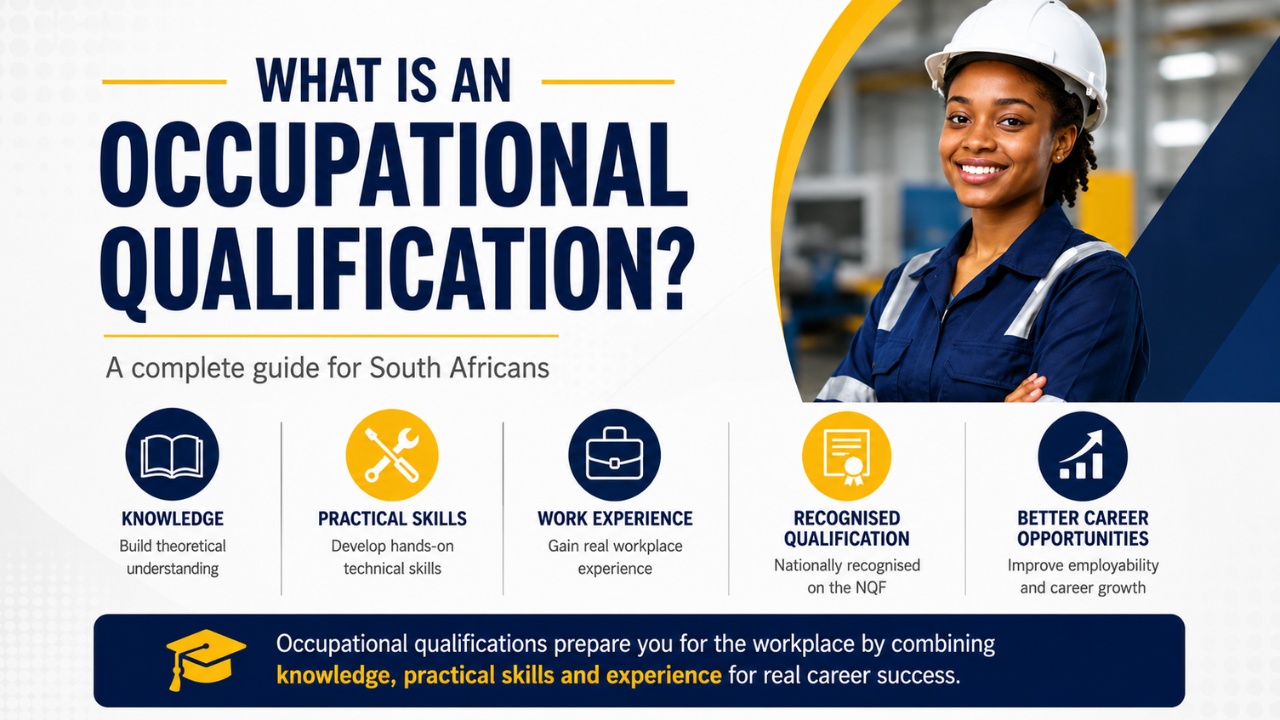
What Is an Occupational Qualification?
An occupational qualification is a nationally recognised qualification designed to prepare learners for a specific occupation or job role.
Unlike purely academic qualifications, occupational qualifications combine:
- Knowledge
- Practical Skills
- Workplace Experience
This integrated approach helps ensure learners develop the competence required to perform successfully within their chosen occupation.
Many occupational qualifications are developed and quality assured through the Quality Council for Trades and Occupations (QCTO) before being registered on South Africa’s National Qualifications Framework (NQF).
Learning a Job Is Different From Studying a Subject
For many years, education in South Africa focused primarily on academic qualifications. Learners completed school, enrolled at a university or college, and earned certificates, diplomas, or degrees based largely on classroom learning.
Today’s workplace looks very different.
Employers increasingly want people who can demonstrate practical competence, not just theoretical knowledge. They want employees who can perform real workplace tasks safely, efficiently, and consistently from the day they begin work.
This is where occupational qualifications play an important role.
Designed with industry input and aligned to real occupations, occupational qualifications help prepare learners for specific careers by combining structured learning with practical workplace experience.
Why Occupational Qualifications Were Introduced
South Africa’s economy needs graduates who are ready for employment.
Many employers previously found that learners possessed theoretical knowledge but lacked practical workplace skills.
Occupational qualifications were introduced to help close this gap by ensuring that learning reflects the actual requirements of industry.
Employers, professional bodies, SETAs, educational institutions, and government all contribute to developing these qualifications.
What Makes Occupational Qualifications Different?
Traditional qualifications often focus heavily on classroom learning.
Occupational qualifications are designed around workplace competence.
A typical occupational qualification consists of three integrated components:
Knowledge Modules
Learners develop the theoretical understanding needed for their occupation.
Practical Skills Modules
Learners practise technical tasks within simulated or training environments.
Work Experience Modules
Learners gain practical experience in real workplaces under supervision.
Together, these three components prepare learners for employment rather than examinations alone.
Which Careers Use Occupational Qualifications?
Occupational qualifications exist across numerous industries, including:
- Engineering
- Construction
- Manufacturing
- Mining
- Agriculture
- Information Technology
- Healthcare
- Financial Services
- Logistics
- Retail
- Hospitality
- Public Administration
Many artisan trades are also based on occupational qualifications.
How Occupational Qualifications Support Learnerships
Many learnerships are built around occupational qualifications.
A learner may complete:
- Structured classroom learning
- Practical training
- Workplace experience
before completing the required assessments.
This allows employers to develop employees while learners work towards nationally recognised qualifications.
Occupational Qualifications and Apprenticeships
Occupational qualifications also play an important role within apprenticeship programmes.
Apprentices develop technical competence through structured learning and extensive workplace experience before progressing towards recognised occupational outcomes.
Who Develops Occupational Qualifications?
Several organisations contribute to South Africa’s occupational qualifications system.
QCTO
Develops and quality assures occupational qualifications.
SAQA
Registers qualifications on the National Qualifications Framework.
SETAs
Support workplace learning and skills development across industries.
Employers
Provide practical industry input to ensure qualifications reflect workplace needs.
Benefits of Occupational Qualifications
Occupational qualifications offer several advantages.
They help learners:
- Develop practical workplace skills
- Improve employability
- Gain nationally recognised qualifications
- Build industry-relevant competence
- Progress into long-term careers
- Continue lifelong learning
For employers, they help create a workforce that is better prepared for modern industry.
Why Occupational Qualifications Matter
South Africa’s future depends on developing skilled people who can contribute immediately within the workplace.
Occupational qualifications strengthen this objective by ensuring education reflects the real needs of employers while improving career opportunities for learners.
As industries continue evolving, occupational qualifications will remain central to workforce development and economic growth.
Thabang Maimela’s Perspective
One thing I’ve noticed through YouthSETA is that many people still assume every qualification follows the same pathway.
Occupational qualifications are specifically designed for employment. They bring together classroom learning, practical skills, and workplace experience to produce graduates who are ready to contribute from day one.
As South Africa continues investing in skills development, I believe occupational qualifications will become even more important because employers increasingly value competence alongside academic achievement.
— Thabang Maimela
Founder & Editor, YouthSETA
Frequently Asked Questions
What is an occupational qualification?
An occupational qualification is a nationally recognised qualification that prepares learners for a specific occupation by combining theoretical learning, practical skills training, and workplace experience.
Who develops occupational qualifications?
Occupational qualifications are developed and quality assured through the QCTO with input from employers, industry experts, SETAs, and education providers.
Are occupational qualifications recognised in South Africa?
Yes. Approved occupational qualifications are registered on South Africa’s National Qualifications Framework (NQF).
Can I get an occupational qualification through a learnership?
Yes. Many learnerships are based on occupational qualifications and combine classroom learning with workplace experience.
Are occupational qualifications only for artisans?
No. Occupational qualifications exist across many industries, including engineering, healthcare, IT, finance, agriculture, logistics, hospitality, manufacturing, and public administration.

I am Thabang Maimela, Founder and Editor of CareersPursuit and YouthSETA, two South African platforms dedicated to helping individuals access employment opportunities, skills development programmes, and career growth resources. Through CareersPursuit, I focus on jobs, internships, apprenticeships, graduate programmes, learnerships, and career advice, while YouthSETA specialises in SETA learnerships, skills programmes, youth development initiatives, and workplace readiness resources. My mission is to make reliable, up to date information more accessible, helping South Africans build skills, improve employability, and navigate their career journeys with confidence. Read more about the author on the About US page.